Monday, September 26, 2022

Pakistan extreme flooding, caused, in part, by glaciers. What’s next?

One-third of Pakistan was underwater as of Sep. 2022. While some amount of flooding has become typical after monsoon rains during the summer, flooding this year was devastating to the people of Pakistan (Rascoe). One reason why the flooding was more extreme, is melting glaciers (Rascoe).

Glaciers are immensely important to high alpine environments, where they are the main source of freshwater. Fauna and flora depend on the melted glacier water, also known as meltwater (Rascoe). In simple terms, a glacier is a large mass of ice, moving on a slope. The glacier can either be on a steep slope like in the mountains, or on a shallow slope such as in Greenland. In high altitudes, snow falls as precipitation, and the glacier grows. It becomes heavier before it begins to move down towards lower elevation areas where it either melts or evaporates into the atmosphere through sublimation (Rascoe). As glaciers move downwards to low-altitude areas, it drags along rocks, sediment, and other bits of debris. As it drags the material, it scratches and grinds the bedrock beneath the glacier, which is called abrasion (How glaciers change the landscape). As it melts, the glacier releases the materials. When pre-existing cracks in the bedrock grow underneath the glacier, large pieces of rock break free and are carried by the glacier (How glaciers change the landscape). As a cycle each year, glaciers grow and melt, changing the bedrock underneath them, and transporting materials. 

In May, a bridge in Pakistan collapsed due to flash flooding caused by a quick release of water from a glacier-fed lake, also called a glacier lake outburst (Fox).

Besides the Arctic and the Antarctic, Pakistan has the most glaciers in the world, over 7200 (Rascoe). In the past, glaciers melt before the monsoon season in Pakistan, creating two peak flood seasons. Climate change is adding two factors to the glacier melt and monsoon seasons. First, climate change is causing the monsoon season to move up in the calendar year, becoming closer to the snowmelt season (Rascoe). In the case of this year, they overlap, creating extreme flooding. Second, climate change is increasing the number of glaciers melting each year. Globally, from 2015 to 2019, there were 70 billion more tons of ice that melted every year in comparison to the period from 2000 to 2004 (Rascoe). As climate change worsens, more of the glaciers melt, and the cycle eventually stops. Small glaciers will form each winter and entirely melt in the summer. 

While the glacier melting in Pakistan is causing political and economic hardship in the country, the glacier melting in Greenland is predicted to have more of an impact on the world as a whole. It is expected that the glacier melting in Greenland, alone, will cause sea levels to rise at least 10.6 inches (Cho). If climate change continues to worsen at the same level as it is, glaciers in Greenland would be responsible for at least 30 inches of sea level rise (Cho). Melting glaciers from the rest of the world would only worsen this outcome.

The left diagram demonstrates the total amount of days that the glacier has melted in the year, to date. The right diagram shows the amount of glacier melt in the previous day (National Snow and Ice Data Center).

What will happen once glaciers melt entirely? In the Arctic, where the glaciers could disappear as early as 2035, the region would be more accessible to material transporting, fossil fuel extraction, and mining (Cho). The United States Geological Survey estimated that 30% of undiscovered gas and 13% of undiscovered oil is within the Arctic Circle, currently underneath ice (Cho). Essentially, the more ice that melts each year, the more of an opportunity is created for climate change to worsen by increasing the amounts of mining, fossil fuel extraction, and exposing ecosystems to human harm. 

A few arguments are important to address in combination with concerns about glacier melting. First, there is the reality that as new shipping routes are opened by melting glaciers, time spent transporting material would decrease (Cho). Specifically, ships could cut through the Arctic, decreasing their emissions by 24% (Melting arctic ice could transform international shipping routes, study finds). In addition, many different precious metals are needed for countries to transition to renewable and clean energy, which could be mined in oceans once covered by glaciers (Cho). Melting glaciers also release historically and geologically significant information such as preserved artifacts.

Even though there are a few small positive outcomes to melting glaciers, the positives do not overpower the negatives of the issue. Climate change is interrupting the process of glaciers growing, changing the bedrock underneath, and melting. As a long term result, sea levels are rising, but on a short term basis, countries such as Pakistan are under political and economical pressure due to receiving the bulk of the impact.

Sources

Cho, Renee. “What Lies beneath Melting Glaciers and Thawing Permafrost?” State of the Planet, Columbia Climate School: Climate, Earth, and Society, 13 Sept. 2022, https://news.climate.columbia.edu/2022/09/13/what-lies-beneath-melting-glaciers-and-thawing-permafrost/.

Fox, Kara. “Pakistan's Melting Glaciers Are 'Erupting' and Worsening Floods.” CNN, 2 Sept. 2022, https://www.cnn.com/2022/09/01/asia/pakistan-flooding-glacier-outbursts-climate-intl/index.html.

“How Glaciers Change the Landscape.” National Parks Service, https://www.nps.gov/articles/howglacierchangethelandscape.htm#:~:text=Glacial%20Deposition&text=Glacier%20can%20also%20shape%20landscapes,it%20flows%20over%20sediment%20beds.

“Melting Arctic Ice Could Transform International Shipping Routes, Study Finds.” ScienceDaily, 20 June 2022, https://www.sciencedaily.com/releases/2022/06/220620152119.htm.

“National Snow and Ice Data Center.” NSIDC Arctic News and Analysis RSS, 12 Sept. 2022, http://nsidc.org/greenland-today/.

Rascoe, Ayesha. “How Melting Glaciers Contributed to Floods in Pakistan.” NPR, 4 Sept. 2022, https://www.npr.org/2022/09/04/1120952641/how-melting-glaciers-caused-by-climate-change-led-to-to-floods-in-pakistan.

Sunday, September 25, 2022

What Happens If We Send Our CO2 Down Rather Than Up?

Human emissions of greenhouse gases aren't slowing down, in fact, they’re speeding up. In recent years, more attention has been put on what should be done with the carbon dioxide that is currently being released. But what can we do with all of the CO2 besides release it into the atmosphere? The answer to this pressing question may lie hidden beneath our feet.

Carbon sequestration is the practice of capturing and storing carbon dioxide from the atmosphere. One form of CCS (Carbon Capture and Storage) is known as carbon mineralization. In this process, carbon dioxide reacts with certain types of rocks, normally igneous or metamorphic, and becomes a carbonate. This permanently traps the carbon in rocks, unable to escape into the atmosphere and act as a greenhouse gas. There are two primary methods of carbon mineralization.


Mineral that might result from mineralizing carbon dioxide (USGS, 2022)

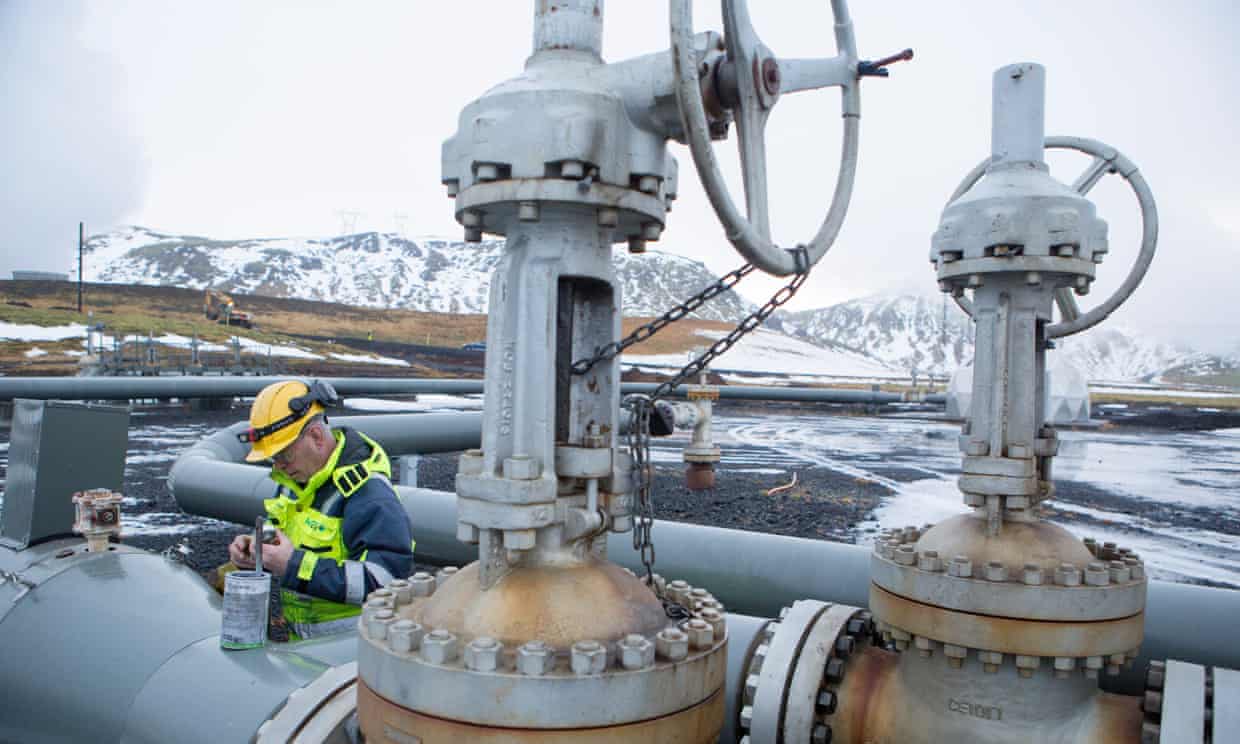
Carbon injection pumps carbon dioxide into wells that lead to igneous and metamorphic rock deposits. There, they can be mineralized by interacting with two types of rock, basalt and ultramafic. Ultramafic rocks have high amounts of iron and magnesium, and are capable of mineralizing CO2 in under two years. Carbon injection was proven effective in Iceland in 2013. The Orca geothermal power plant captured its own carbon dioxide emissions, mixed them with water, and pumped them into the volcanic basalt rock below. The experiment injected 175 tons of CO2 into the ground, and found that 95% of the gas had mineralized into carbonate within two years (Hirji, 2016). The success Orca found proves that the technology is ready, but carbon mineralization still must prove it is safe and cost-effective before policymakers begin to consider implementing it.


Engineer at the Orca power plant in Iceland

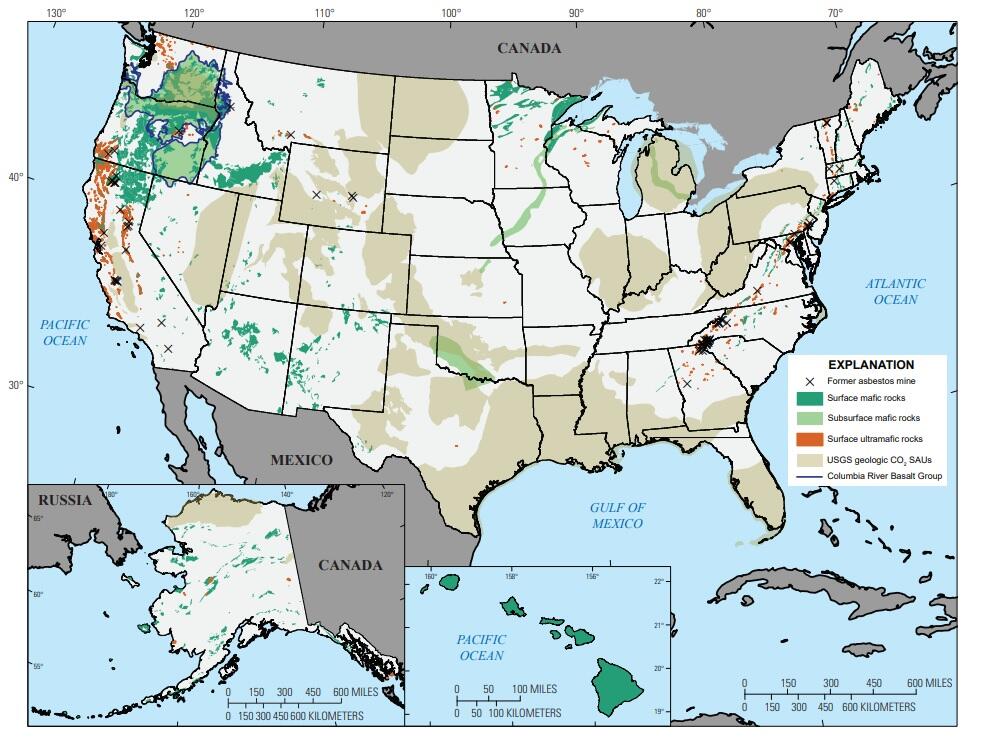
Carbon can also be mineralized by exposure to basalt and ultramafic rocks at the surface. These often come in the form of crushed mining waste. This process is faster than injection, but has a lower overall capability for carbon storage due to the difference in quantity of rock above ground versus underground. This method is being utilized on the rocks of the Oman Gulf, but has been described as only “a drop in the bucket” (Fountain, 2018).


This figure shows areas in the US with the potential for carbon mineralization (USGS, 2022)

Carbon mineralization is currently being utilized in only a few places around the world, but it’s a good step in the right direction. We have a long way to go before it even begins to have a notable effect on CO2 emissions, but the future looks promising for this form of carbon capture. 


Citations:

Fountain, Henry. “How Oman's Rocks Could Help Save the Planet.” The New York Times, The New York Times, 27 Apr. 2018, https://www.nytimes.com/interactive/2018/04/26/climate/oman-rocks.html.

Hirji, Zahra. “Iceland Experiment Successfully Turns CO2 Emissions into Rock.” Inside Climate News, 22 July 2022, https://insideclimatenews.org/news/09062016/iceland-study-ccs-carbon-capture-storage-climate-change-iceland-co2-rock/.

US Geological Survey. “Making Minerals-How Growing Rocks Can Help Reduce Carbon Emissions: U.S. Geological Survey.” Making Minerals-How Growing Rocks Can Help Reduce Carbon Emissions | U.S. Geological Survey, 8 Mar. 2019, https://www.usgs.gov/news/featured-story/making-minerals-how-growing-rocks-can-help-reduce-carbon-emissions#:~:text=Carbon%20mineralization%20is%20the%20process,escape%20back%20to%20the%20atmosphere.


Thursday, September 22, 2022

Wind, lakes, and sand dunes on Mars!

As an article published last month in Journal of Geophysical Research: Planets reveals, images taken by the Curiosity rover on Mars show evidence of sedimentary rocks and erosion. This is significant because Mars is thought to have much less energy than Earth's core and to have virtually no plate tectonics which are the driving force behind the Earth rock cycle. 

These photos captured by Curiosity show what appear to be ancient bedded sand dunes above which is an unconformity with more material on top of that (Watkins et al.). Basically modern erosion, comprised almost entirely of wind has exposed ancient sedimentary rock which shows evidence of ancient erosion also likely facilitated by wind. The red line in the image below shows the location of the exposed unconformity of missing rock weathered away.

Details are in the caption following the image Details are in the caption following the image

The sediment below the unconformity shows evidence of being sand dunes similar to this canyon wall (second image from top) from White Sands National Park on Earth (Gardiner). This is significant because the type of sediment that comprises eolian dune fields could have initially been formed in a lake environment as shown in the schematic above. This shows the history of the region, transitioning from a wet lake environment with depositing sediments, to a drier climate with wind erosion forming and depositing dune fields, to the burial and creation of the dunes to the strata we see today thanks to modern erosion. This shows on a different scale than on Earth a modified rock cycle driven primarily by wind with on a planet with an atmosphere 1% the volume of our own (Perkins)!

One last point of note that the Geophysical Research article poses is that "Understanding the sedimentary rock cycle is especially significant in the search for ancient biosignatures on Mars as virtually all remnants of Earth's earliest biosphere are preserved in sedimentary rocks that were formed in this fashion" (Watkins et al.). 


Gardiner, Lisa. Dune Sediment - Windows to the Universe. 2004, https://www.windows2universe.org/earth/geology/sed_dunes.html.

Perkins, Robert. Wind Drives Geology on Mars These Days. 2022, https://phys.org/news/2022-09-geology-mars-days.html.

Watkins, Jessica A., et al. “Burial and Exhumation of Sedimentary Rocks Revealed by the Base Stimson Erosional Unconformity, Gale Crater, Mars.” Journal of Geophysical Research: Planets, vol. 127, no. 7, John Wiley and Sons Inc, July 2022, doi:10.1029/2022JE007293.